ELI5
Explain it like I’m five絶対音感(ぜったいおんかん)What is perfect pitch?
日本語English
In one linePerfect pitch (absolute pitch) is the ability to name the note of a sound you hear accurately, without hearing a reference note first.
Perfect pitch is being able to hear a sound and know its note right away, like “that’s C” or “that’s A.” You don’t need another note to compare it with. Some people hear note names not just on a piano, but in phone rings and school bells too. People say it is easier to get if you hear lots of music when you are small. Getting it as a grown-up is said to be hard. There is another skill called relative pitch. It means judging a note by how it sits next to other notes. Grown-ups can train that one. Good news for anyone who started piano late.
- pitch
- 音の高さ
- note
- 音符・音名
- compare
- 比べる
- relative
- 相対的な
- train
- きたえる
Go deeper
How many people have it?
The figure “1 in 10,000” is often quoted, but the real share is not known, and that number itself may not be accurate. A 2019 review found that at least about 4% of music students have it. Many professional musicians do not have it either. Most play using relative pitch, hearing notes by how they relate to each other.
When and how does it develop?
One idea is that perfect pitch can only be learned during a limited window in early childhood, called a critical period. It is also reported to be more common among speakers of tonal languages, such as Mandarin or Vietnamese, where the pitch of a word changes its meaning. Early experience linking pitches with their names seems to matter a great deal.
There is more than one standard
Tuning A to 440 Hz was agreed at an international conference in London in 1939; before that, it varied by country and era. Today many orchestras tune a little higher, around 442 to 444 Hz, and baroque music on period instruments is often played at a lower 415 Hz. People with perfect pitch can find a shifted standard unpleasant. A useful ear can also be a source of stress.
How people use it
- “She heard the microwave beep and said, ‘That was a B.’”
- “I don’t have perfect pitch, but I trained my relative pitch and can harmonize now.”
Questions people ask
- How common is perfect pitch?
- “1 in 10,000” is often quoted, but the real share is unknown. One review found at least about 4% among music students.
- Can perfect pitch be a problem?
- Some people find it hard to play with instruments tuned to a different standard, or to sing a song in a different key, because the shift bothers them.
- How many hertz is the note A?
- An international conference in 1939 set it at 440 Hz. Many orchestras today tune a little higher, around 442 to 444 Hz.
Sources:Wikipedia「絶対音感」、Wikipedia (English) “Absolute pitch”
Your turn
Do chimes sound like do-re-mi?
Tap to see what everyone said.
Related words
 Kohaku Uta Gassen
 Chaku-melo (phone ringtones)Chaku-melo is short for “incoming call melody,” the tune a phone plays when someone calls.
 Oricon chartThe Oricon chart is a music sales ranking from Oricon Inc., published since the late 1960s, …
 Chill
 Orchestra seatingQ. Is orchestra seating always the same?
A. There is not just one way to sit. Seats can change depending on the …
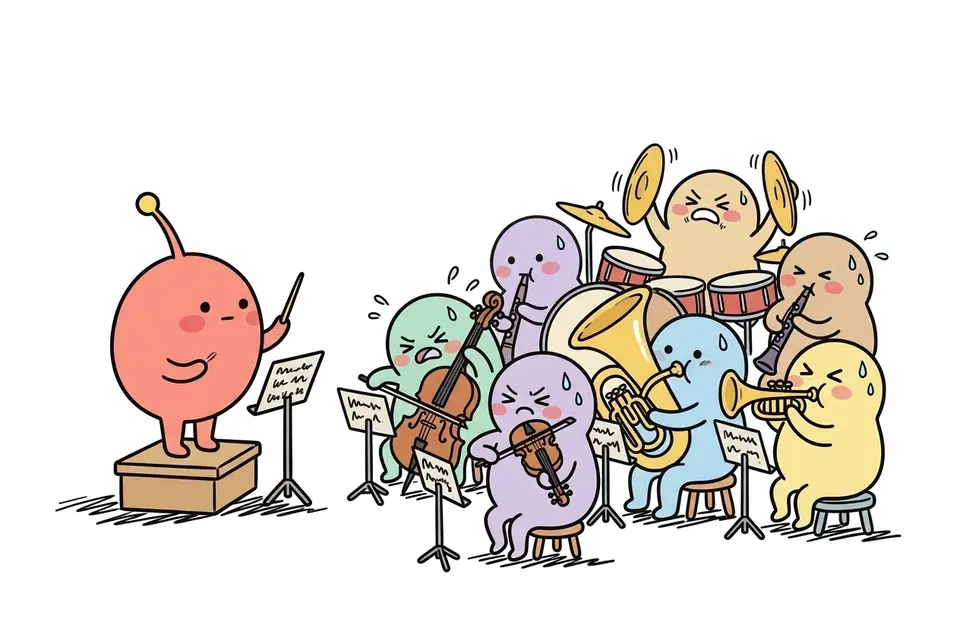 ConductorA conductor stands in front of an orchestra or choir and brings the whole performance together.
 Beethoven’s Ninth (Daiku)Q. Was the Ninth written for the end of the year?
A. It was not written as a year-end piece. Playing it at the end of the…
 Chord progressionA chord progression is the order in which chords change in a piece of music. It forms the fr…
 Royal road progressionQ. Is “royal road progression” a term used worldwide?
A. It is not a worldwide music term. The name spread in Japan and is no…
 BPM
 City popQ. Is city pop a new genre?
A. It is not a new genre. These are Japanese songs from over 40 years a…
 EnkaQ. Was enka always about love and sake?
A. It was not about love and sake from the start. In the Meiji era, “en…
Source (in Japanese): Wikipediaで「絶対音感」を調べる